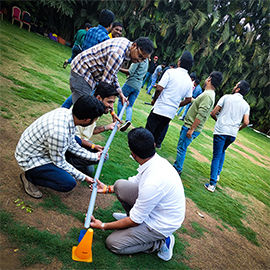
Outbound Team Building Activities
Experiential learning, not just a day outdoors — competency-mapped activities, ToT-accredited facilitation and the debriefs where the actual training happens. Half-day programs to two-day residential OBTs.
An outbound is not an outing
An outing buys energy: games, food, a great day, better Monday morale. An outbound buys learning: each activity is chosen against a competency — communication, trust, planning under constraint — and the activity itself is only half the format. The other half is the facilitated debrief, where a trained facilitator turns what just happened on the ground into what keeps happening at work. Skip the debrief and you have paid training prices for a picnic.
Buying signal: if the budget is an engagement budget and the goal is a great day, you want our outdoor formats — cheaper, louder, zero homework. If the budget is a training budget and someone will ask "what did they learn?", this page is yours.
How experiential learning actually runs
Every OBT activity cycles through four stages — the ground rules of the craft since outbound training existed.
The task, the rules, the constraint
Teams get an objective and deliberately imperfect resources. The constraint is the curriculum — how a group behaves when it cannot have everything is the behaviour worth studying.
The activity, unrescued
Facilitators observe and note — who planned, who steamrolled, who went silent, where the plan died. We do not rescue struggling teams; struggle is the data.
Where the training happens
The facilitated review: what happened, why, and where the same pattern shows up in your Tuesday stand-up. This is the half of OBT that untrained providers skip — and the half that justifies the invoice.
Back to work, on record
Teams leave with named behaviours to keep and drop; for L&D-sponsored programs we provide an observation summary your team leads can follow up on.
Twelve OBT formats, mapped to competencies
Chosen by what the debrief needs to surface — not by what photographs best.
Trust & communication
Instruction-giving, listening and dependence — the foundations


Planning & problem-solving
Resource allocation, silo-breaking and process improvement


Leadership under pressure
Fear, ambiguity and self-organisation — the residential-format anchors


Three ways to run an outbound
| Format | Where & how long | What fits | Honest note |
|---|---|---|---|
| Half-day OBT | Resort lawn or campus grounds · 3–4 hrs | 3–4 ground activities + debriefs, one competency theme | Good taster; behaviour change needs more contact time |
| Full-day camp OBT | Adventure camp · 6–7 hrs | Full cycle across 5–6 activities incl. one ropes element | The workhorse format — best learning per rupee |
| 2-day residential OBT | Camp or resort · overnight | Progressive difficulty, night navigation, campfire reflection, transfer planning | Where deep-trust outcomes actually happen; budget accordingly |
Facilitation is the product. Ours is accredited.
ToT-accredited lead facilitators
Outbound lives or dies in the debrief, and debriefing is a trained craft — our lead facilitators carry Training-of-Trainers accreditation, stated in every proposal.
Competency mapping before activity selection
The brief starts with what L&D wants changed, not with our favourite props — activities are chosen to surface those behaviours, then debriefed against them.
Certified adventure operations
Ropes and height elements run with certified operators, rated equipment, screening and first-aid on the ground — the safety protocol ships with the proposal.
Reporting L&D can use
For sponsored programs: observation summaries and team-level themes, written for the manager who will run the follow-up 1:1s — not a photo dump.
Outbound training, answered
An outing optimises for fun and energy; an outbound is structured experiential learning — activities selected against competencies, run through brief–experience–debrief–transfer, delivered by trained facilitators. The visible difference is the debrief; the invisible one is which budget it comes from and what your leadership expects back.
Half-day programs typically run ₹900–₹1,800 per person; full-day camp OBTs ₹1,500–₹2,800 including camp access and activities; two-day residential programs ₹4,000–₹8,000 including stay and meals. Facilitation depth, ropes elements and group size move the number — proposals itemise all three.
Adventure camps and OBT-ready resorts within 90 minutes of each hub — Kanakapura Road and Nandi belts for Bangalore, Lonavala–Kolad for Mumbai and Pune, Sohna–Aravalli belt for Delhi NCR, and ECR-side camps for Chennai. Campus-lawn programs run at your office for half-day formats.
Honestly: a one-day OBT will not transform a team, and anyone promising measurable behaviour change from six hours outdoors is selling. What it reliably produces is shared vocabulary and surfaced patterns — which compound when managers follow up. That is why our reports are written for follow-up, and why repeat cohorts outperform one-offs.
Yes — ground activities need planning more than athleticism, height elements are optional with parallel roles, and all physical modules carry screening and first-aid cover. Facilitators adjust intensity per group; nobody is benched from the learning.
Tell us the competency gap and the headcount
A program outline with activity mapping, format options and costs — within 24 hours.