Campus to Corporate Training
The eight-module transition program that turns graduate hires and interns into colleagues — workplace behaviours, personal effectiveness and ownership, taught through simulations and role plays, not lectures.
The gap between campus and corporate is structural — and closing it is trainable
A campus rewards individual scores on defined problems with fast feedback. A workplace rewards team outcomes on ambiguous problems with feedback that arrives quarterly, if at all. Nobody warned your new hires that the rules changed — and nobody briefed your managers that this cohort brings expectations about autonomy, purpose and communication that earlier batches did not.
Left alone, the gap shows up as early attrition, manager frustration and six months of lost productivity per hire. Addressed early — in the induction window, before habits set — it closes fast, because the skills involved are concrete and teachable: how to take a brief, ask for feedback, manage time against competing owners, and behave like someone others want on their team.
Eight modules, built on named frameworks
Not motivation-speak — working tools your hires apply the same week: Johari Window, PDSA, root-cause analysis, ownership models.
Building a Corporate Persona
What success actually looks like at work — the behaviours that get noticed, and workplace etiquette that isn't taught anywhere.
Your Personal Brand at Work
Self-awareness via the Johari Window — moving strengths and blind spots from unknown to known.
Personal Effectiveness
Limiting vs empowering behaviours, first impressions and the credibility window every new hire gets exactly once.
Personal Leadership
Problem-mindset vs solution-mindset, recognising personal strengths, and the four drivers of leading yourself first.
Working Across Generations
Generational values without the stereotypes — team cohesion and managing conflict with colleagues twice your age.
Taking Initiative
Seven ownership behaviours and the accountability mental models that separate task-doers from teammates.
Managing Complexity
Big-picture thinking, root-cause analysis and the PDSA cycle — structured problem-solving on real workplace cases.
Communication for Success
Adapting to personality styles, diplomacy and tact, and active listening — practised live, not described.
Practice-heavy by design
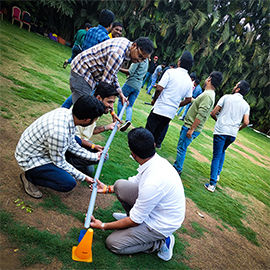
New hires have sat through enough lectures to earn a degree. This program makes them do the thing, then coaches the doing.
Simulations
Real workplace scenarios — a slipping deadline, a vague brief, a difficult stakeholder — run live and coached.
Role plays
Feedback conversations, escalations and first-week interactions rehearsed before they happen for real.
Demonstrations
Frameworks shown working on concrete cases before participants apply them to their own.
Exercises & debriefs
Hands-on application with facilitated review — the same debrief craft our outbound programs are built on.
Sized to your induction calendar
| Format | Duration | Best for | Note |
|---|---|---|---|
| Core program | 2 days | GET/MT batches and intern cohorts during induction week | All 8 modules at working depth; 25–30 per batch |
| Core + Outbound day | 3 days | Cohorts where bonding matters as much as behaviours | Day 3 applies the modules on the ground — OBT format, debriefed against the curriculum |
| Induction partnership | Across your induction | Large campus intakes (100–500+) in parallel batches | Modules slotted into your induction calendar; consistent delivery across batches and cities |
Delivery at your office, training centre or a residential venue we source — and the program is customised to your competency framework before delivery, which is what the Cipla and TVS engagements below were built on.
See also: Outbound training format
On record, by name
“For both our interns and new hires, Trebound's training programs have been invaluable. The sessions are well-crafted to align with Cipla's core competencies, and the positive feedback from participants, especially those from top-tier institutes, speaks volumes about its effectiveness.”
“We've partnered with Trebound for our Campus to Corporate training for three straight years, and the experience has been exceptional. The program captures TVS leadership competencies perfectly, and even our new hires from tier 1 institutes admired its design and depth.”
Inside the program
Before you brief us
Typically ₹2,500–₹4,500 per participant for the 2-day core program at batch sizes of 25–30, with per-head rates improving across parallel batches for large intakes. The 3-day format adds the outbound day's camp and activity costs. Proposals itemise facilitation, materials and customisation separately.
Before delivery we map the modules to your competency framework and collect real scenarios from your managers — the simulations your hires practise are your workplace, not generic cases. That mapping step is why client programs like Cipla's align to their core competencies rather than ours.
25–30 per batch keeps role plays and coaching real — larger single rooms turn practice into theatre. Big intakes run as parallel or sequential batches with the same facilitators and materials, so batch 10 gets the same program as batch 1.
Weeks 1–4, before habits set and first impressions harden. Running it after six months turns a formation program into a correction program — more resistance, less payoff. For interns, the first fortnight.
Soft-skills programs teach standalone skills to anyone; campus-to-corporate is a transition program — it sequences behaviours, expectations and workplace navigation specifically for people in their first professional role, anchored to your organisation's competencies and delivered inside the induction window.
Tell us the cohort and the joining month
A program outline mapped to your competencies, with batch plan and costs — within 48 hours.